


 English
 русский
 Español
 عربى
عربى
Content
How Each Pump Type Moves Fluid
The most fundamental difference between a positive displacement (PD) pump and a centrifugal pump lies in the mechanism used to move fluid — and that single difference cascades into nearly every performance characteristic you need to evaluate during selection.
A centrifugal pump transfers kinetic energy to the fluid through a spinning impeller. As the impeller rotates, it draws liquid into the eye at its center and flings it outward toward the casing wall, converting velocity into pressure at the discharge port. The process is continuous, non-pulsating, and highly dependent on the fluid's physical properties — especially viscosity. For a deeper breakdown of the available variants, see types of centrifugal pumps and their industrial applications.
A positive displacement pump, by contrast, physically traps a fixed volume of fluid in a cavity — through gears, pistons, lobes, screws, or a flexible diaphragm — and mechanically forces it through the discharge line. Each stroke or revolution moves a known, defined quantity of fluid. The result is a flow rate that stays nearly constant regardless of downstream pressure, a behavior fundamentally different from any centrifugal design.
Flow Rate, Pressure, and the Performance Curve
Centrifugal pumps operate along a performance curve: as system backpressure rises, flow rate drops. At the best efficiency point (BEP), hydraulic losses are minimized and the pump delivers its rated output at optimal energy consumption. Stray too far from BEP — either by throttling excessively or by running at low head — and efficiency falls, heat builds up, and mechanical wear accelerates.
Positive displacement pumps behave differently. Their flow-pressure curve is nearly vertical: flow remains steady across a wide pressure range, dictated by pump speed rather than system resistance. This predictability makes PD pumps the default choice for metering and dosing applications where a specific volume must be delivered per cycle, regardless of what happens downstream.
One practical consequence: a PD pump running against a closed discharge will build pressure until something breaks. A properly sized relief valve or bypass loop is non-negotiable in any PD pump installation. Centrifugal pumps simply stall at shut-off head without damaging themselves (though prolonged dead-heading causes overheating).
Pairing a centrifugal pump with a variable frequency drive (VFD) closes much of the gap, allowing flow adjustments across a wide range while preserving efficiency — a combination increasingly favored in temperature control and HVAC systems where load conditions fluctuate continuously.
Viscosity, Solids, and Shear Sensitivity
Fluid properties often determine which pump type is viable before any pressure or flow calculation takes place.
Centrifugal pumps are optimized for low-viscosity liquids — water, thin solvents, light chemicals. As viscosity rises above roughly 100–200 cP, frictional losses inside the pump increase sharply, flow drops, efficiency collapses, and motor load climbs. Running a centrifugal pump on a fluid it was never designed for doesn't just underperform: it can overheat the unit and void the warranty.
Positive displacement pumps are largely unaffected by viscosity changes. Many gear and progressive cavity designs actually see improved volumetric efficiency as the fluid thickens, because viscous fluid seals the internal clearances more effectively. This is why PD pumps dominate in petroleum, adhesive, syrup, and polymer applications. For abrasive slurries and heavily particle-laden streams, a corrosion-resistant and wear-resistant slurry pump built on PD principles offers robust durability that centrifugal designs cannot match in continuous service.
Shear sensitivity is another critical factor. Centrifugal impellers spin at high speed, applying significant shear forces to the fluid. For emulsions, biological broths, certain polymers, and food-grade materials that change structure under shear, this can cause irreversible product damage. Diaphragm and peristaltic PD pumps move fluid gently, making them the standard for shear-sensitive applications in pharmaceutical and food processing lines.
Self-Priming, Dry Running, and Installation Constraints
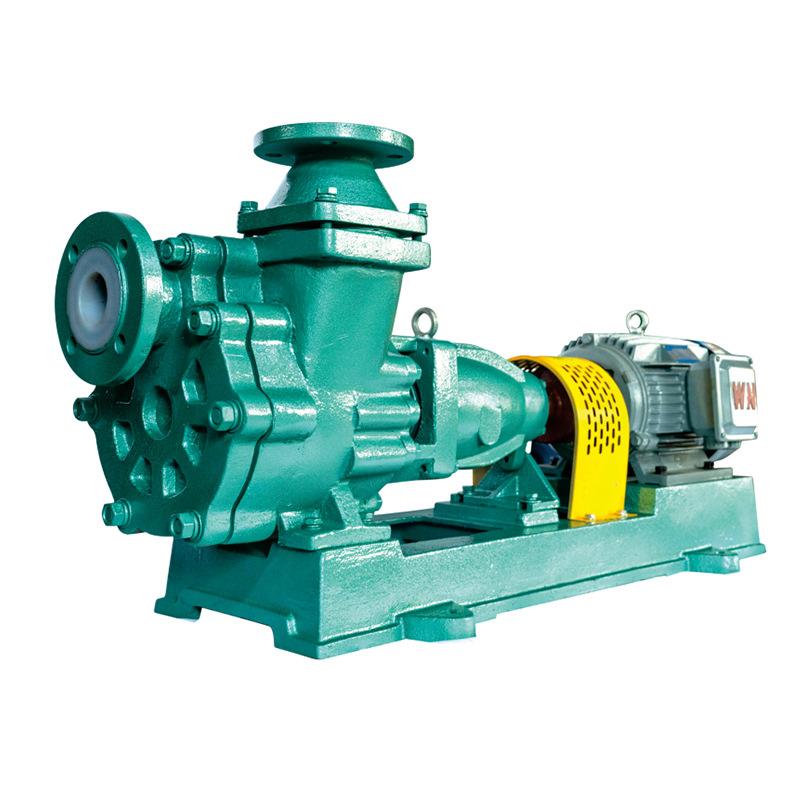
Most centrifugal pumps cannot self-prime. They require liquid in the pump casing before startup to create the hydraulic action that drives flow — air in the casing simply spins without building pressure. In practice, this means the pump must be installed below the supply liquid level, or a priming system must be included. Self-priming centrifugal variants exist, but they require an additional liquid reservoir in the casing and still cannot handle air ingestion during operation.
Positive displacement pumps — particularly diaphragm pumps — are inherently self-priming. They can lift fluid from a lower vessel, start dry, and handle intermittent air ingestion without damage. This makes them far more forgiving in field installations, portable setups, and applications where fluid level fluctuates.
Dry running is a related risk. Running a centrifugal pump without liquid destroys the mechanical seal in minutes. Many PD pump designs, including diaphragm pumps, tolerate dry operation for extended periods, a meaningful advantage in processes with unpredictable feed supply.
Maintenance and Total Cost of Ownership
Centrifugal pumps are widely regarded as low-maintenance equipment. With few moving parts — essentially an impeller, shaft, and seal — there is limited wear surface. Routine maintenance centers on mechanical seal inspection, bearing lubrication, and impeller clearance checks. Mean time between failures is high when pumps are correctly sized and operated near BEP.
Positive displacement pumps carry more mechanical complexity. Gear pumps have tight clearances prone to wear from abrasives. Diaphragm pumps require periodic diaphragm replacement, typically every 8,000–20,000 operating hours depending on material and duty. Piston and plunger pumps require valve and packing maintenance. The total parts count is higher, and the maintenance schedule is more demanding.
That said, the relevant comparison is total cost of ownership, not purchase price alone. A centrifugal pump running at 40% efficiency on a high-viscosity fluid, requiring frequent seal replacements, will cost significantly more over five years than a properly specified PD pump that runs steadily within its design envelope. The right pump for the fluid is always the lower-cost pump over time.
Side-by-Side Comparison
| Parameter | Centrifugal Pump | Positive Displacement Pump |
|---|---|---|
| Operating Principle | Kinetic energy via rotating impeller | Fixed volume displacement per cycle |
| Flow vs Pressure | Flow decreases as pressure rises | Constant flow regardless of pressure |
| Viscosity Handling | Low viscosity only (≤100 cP typical) | High viscosity; efficiency may improve |
| Self-Priming | Requires priming (most designs) | Naturally self-priming |
| Dry Running | Damages seals immediately | Tolerates short dry runs (diaphragm types) |
| Shear Sensitivity | High shear — unsuitable for sensitive fluids | Low shear — safe for delicate media |
| Flow Consistency | Pulsation-free, continuous | Pulsating (dampeners may be needed) |
| Closed Discharge Risk | Stalls at shut-off head | Pressure spike — requires relief valve |
| Typical Applications | Water supply, HVAC, chemical transfer | Dosing, slurry transfer, viscous fluids |
| Maintenance Complexity | Low — fewer moving parts | Moderate to high — wear parts cycle |
Choosing the Right Pump for Your Application
The selection decision usually comes down to three questions answered in sequence.
What is the fluid viscosity? If the liquid exceeds 200 cP, a centrifugal pump is rarely the right answer. Move directly to evaluating PD options: gear pumps for clean, high-viscosity liquids; diaphragm pumps for corrosive or particle-laden streams; progressive cavity pumps for pastes and high-solid slurries.
Is precise flow metering required? If dosing accuracy matters — chemical injection, pharmaceutical batch processing, food additive delivery — a PD pump's fixed-volume-per-stroke characteristic is essential. Centrifugal pumps, even with VFDs, cannot match the metering precision of a diaphragm or plunger pump.
What are the pressure and flow conditions? For large-volume, low-pressure transfer of clean, low-viscosity fluids, centrifugal pumps deliver the lowest capital cost, the simplest installation, and the best energy efficiency near BEP. For high-pressure injection, high-viscosity transfer, or applications requiring consistent flow independent of system pressure changes, PD pumps provide capabilities centrifugal designs cannot replicate.
For corrosive chemical service, a fluorine-lined centrifugal pump for corrosive chemical media or a fluoroplastic-bodied diaphragm pump are the two dominant options — the choice between them ultimately rests on the viscosity and solid content of the specific fluid. For general industrial service with clean liquids in the standard temperature range, stainless steel centrifugal pump specifications cover a broad range of flow and head combinations at competitive cost. Matching the pump type to the fluid and process conditions — rather than defaulting to the most familiar technology — is what separates a reliable long-term installation from a chronic maintenance problem.

 Tel: +86-15256327373
  E-mail:
  Add: Anhui Southern Chemical Pump Co., Ltd. The intersection of Kaicheng Road and Fuxing Road, Jing Country, Xuancheng City, Anhui Province