


 English
 русский
 Español
 عربى
عربى
Content
- 1 What a Vertical Centrifugal Pump Is and When to Use One
- 2 How a Vertical Centrifugal Pump Works
- 3 Main Types of Vertical Centrifugal Pumps
- 4 Vertical vs. Horizontal Centrifugal Pump: Key Differences
- 5 Key Performance Parameters and How to Read Them
- 6 Material Selection for Vertical Centrifugal Pumps
- 7 Common Applications of Vertical Centrifugal Pumps
- 8 Installation Considerations That Affect Long-Term Performance
- 9 Maintenance Practices That Extend Service Life
- 10 Energy Efficiency and Variable Speed Drives
- 11 Relevant Standards and Specifications
What a Vertical Centrifugal Pump Is and When to Use One
A vertical centrifugal pump is a rotodynamic pump in which the shaft and impeller are oriented vertically, allowing the pump to draw fluid from below and discharge it upward or horizontally — often while the motor remains completely above the liquid. This design is the preferred choice wherever installation space is limited, where the pump must operate submerged or semi-submerged, or where a horizontal pump's footprint simply cannot be accommodated.
Vertical centrifugal pumps appear across an extraordinarily wide range of industries: municipal water supply, cooling water systems in power plants, chemical processing, irrigation, oil and gas, and marine bilge applications. Understanding how they work, where they outperform horizontal alternatives, and how to select and maintain them correctly saves significant cost and downtime over the life of any installation.
How a Vertical Centrifugal Pump Works
The operating principle is identical to any centrifugal pump: a rotating impeller imparts kinetic energy to the fluid, which is then converted to pressure energy as the fluid slows through the volute or diffuser casing. What distinguishes the vertical type is geometry and installation orientation.
In a typical vertical centrifugal pump:
- The motor sits at the top, mounted on a motor support column or discharge head.
- A long drive shaft runs vertically through a column pipe down to the impeller bowl assembly.
- Fluid enters the impeller eye at the bottom, gains velocity through the rotating impeller, and is diffused upward through the bowl stages.
- Discharge occurs at the top of the column into a horizontal or vertical outlet.
Because the impeller operates below the liquid surface, vertical centrifugal pumps are inherently self-priming in most sump or wet-pit installations. This eliminates the priming complexity that plagues many horizontal pump setups in low-suction-head conditions.
Single-Stage vs. Multi-Stage Bowl Assemblies
A single-stage vertical pump uses one impeller and is suited to high-flow, lower-head applications. Multi-stage designs stack multiple impeller bowls in series along the same shaft, with each stage adding pressure. Multi-stage vertical turbine pumps can generate heads exceeding 600 meters, making them the dominant choice for deep-well water supply and high-pressure industrial circuits.
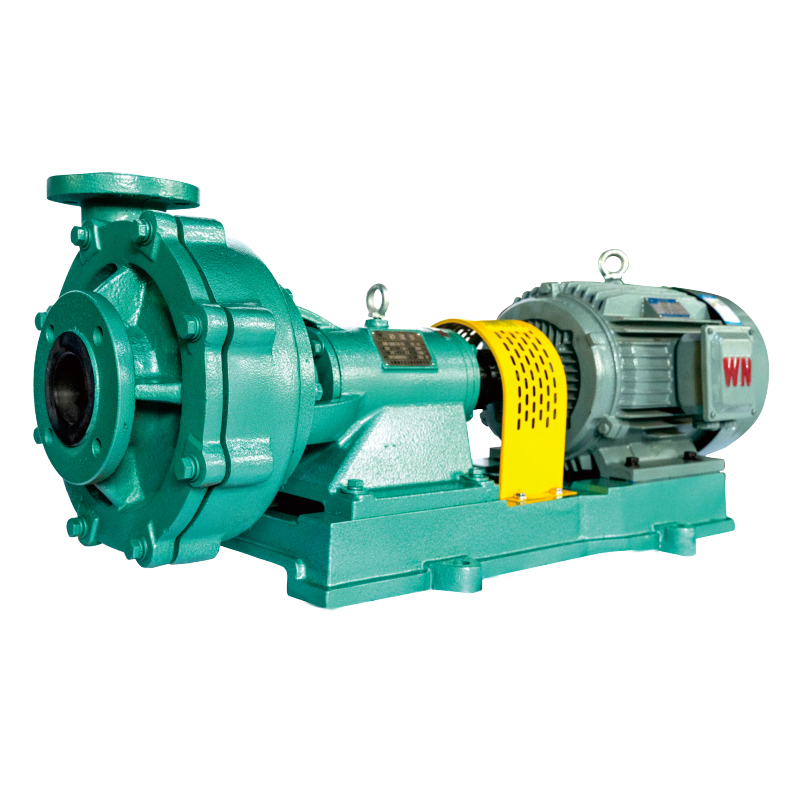
Main Types of Vertical Centrifugal Pumps
The category "vertical centrifugal pump" covers several distinct configurations. Selecting the correct type requires understanding their structural differences and intended service conditions.
Vertical Turbine Pump (VTP)
The vertical turbine pump is the most widely deployed type in water supply and irrigation. It consists of a surface-mounted motor, a column pipe of adjustable length, and a multi-stage bowl assembly at the bottom. VTPs are installed in open sumps, cans, or drilled wells. Column lengths ranging from 3 to over 300 meters are standard, making them uniquely suited for deep groundwater extraction. Municipal water systems worldwide rely on VTPs for their reliability and efficiency at high flow rates.
Vertical Inline Pump
The vertical inline pump mounts directly in a pipeline, with suction and discharge ports on the same centerline. The motor sits vertically above the casing. This configuration requires no baseplate and has a floor footprint often 60–70% smaller than an equivalent horizontal pump. Vertical inline pumps are the standard choice in HVAC building services, chilled water circulation, and fire protection systems where space is at a premium and the pump must remain accessible for maintenance.
Vertical Sump Pump (Wet-Pit Pump)
Designed to operate with the pump casing submerged in a sump or tank, the vertical sump pump keeps the motor safely above the liquid. These are common in chemical plant sumps, wastewater lift stations, and industrial process pits. Column lengths are typically shorter (1–6 meters), and the construction material — cast iron, stainless steel, or exotic alloys — is matched to the corrosivity and temperature of the process fluid.
Can-Type (Barrel) Vertical Pump
Where there is no open sump, a can-type vertical pump installs the bowl assembly inside a fabricated barrel or can vessel. The entire assembly sits above grade. This design is widely used in LNG terminals, offshore platforms, and refinery pump-out services where process fluid must be handled in a closed, controlled environment.
Vertical vs. Horizontal Centrifugal Pump: Key Differences
The choice between vertical and horizontal centrifugal pumps is rarely arbitrary. Each has a defined operational advantage depending on the installation context.
| Criterion | Vertical Centrifugal Pump | Horizontal Centrifugal Pump |
|---|---|---|
| Floor Space | Small — minimal footprint | Larger — baseplate and coupling required |
| Suction Conditions | Excellent — impeller below liquid level | Requires positive suction head or priming |
| Priming | Self-priming in wet-pit installation | Often requires priming system |
| Bearing Accessibility | More complex — shaft removed upward | Easy access from both ends |
| Deep-Well Application | Standard — column can extend hundreds of meters | Not suitable |
| Motor Protection from Fluid | High — motor elevated above liquid | Moderate — depends on seal integrity |
| Maintenance Complexity | Higher — pulling shaft and bowls | Lower — easier to disassemble in place |
| Typical Flow Range | Wide — from 1 m³/h to >10,000 m³/h | Wide — comparable range |
The conclusion from this comparison is practical: vertical centrifugal pumps are superior when space, suction head, or depth of fluid source are the primary constraints. Horizontal pumps retain the advantage in applications requiring frequent, easy maintenance access or where the fluid source is at or above grade.
Key Performance Parameters and How to Read Them
Selecting a vertical centrifugal pump requires evaluating several interconnected parameters. Getting these right at the specification stage prevents both undersizing (which kills performance) and oversizing (which wastes energy and accelerates wear).
Flow Rate (Q)
Flow rate is the volume of liquid the pump must deliver per unit time, expressed in m³/h, L/s, or GPM. Always specify the required flow at the actual operating condition — not a design maximum that may rarely occur. Operating consistently far left or right of the Best Efficiency Point (BEP) on the pump curve accelerates impeller wear and increases vibration.
Total Head (H)
Total head is the total energy per unit weight the pump must impart to the fluid, accounting for elevation change, friction losses in piping, and pressure at the discharge point. It is expressed in meters (or feet) of liquid column. For multi-stage vertical turbine pumps in deep-well service, the static water level depth plus drawdown plus surface piping friction losses all contribute to the required total head.
Net Positive Suction Head Required (NPSHr)
NPSHr is the minimum suction energy the pump needs to avoid cavitation — a destructive phenomenon where vapor bubbles form and collapse within the impeller, causing pitting and noise. The available NPSH at the installation (NPSHa) must always exceed NPSHr by at least 0.5–1.0 meter as a safety margin. Vertical pumps with submerged impellers generally have a favorable NPSHa, which is one of their core operational advantages.
Specific Speed (Ns)
Specific speed is a dimensionless index that describes the impeller shape best suited to a given combination of flow and head. Low specific speed impellers (radial flow) suit high-head, low-flow applications. High specific speed impellers (mixed or axial flow) suit low-head, high-flow conditions. Most multi-stage vertical turbine pumps use radial or mixed-flow impellers in their bowl stages.
Pump Efficiency
Efficiency at the BEP for modern vertical centrifugal pumps typically ranges from 70% to 90%, depending on size and design. Large municipal vertical turbine pumps with bowl diameters above 300 mm routinely achieve efficiencies in the mid-to-high 80s. Selecting a pump with a BEP close to the actual operating point is one of the most impactful decisions for long-term energy cost.
Material Selection for Vertical Centrifugal Pumps
The fluid being pumped dictates material choices across every wetted component — impeller, bowl, column pipe, and shaft. Using incorrect materials is one of the leading causes of premature pump failure.
| Fluid / Service | Impeller & Bowl Material | Shaft Material | Notes |
|---|---|---|---|
| Clean water, irrigation | Cast iron or bronze | Stainless steel 410 | Standard construction, cost-effective |
| Seawater / brackish water | Duplex stainless / Ni-Al bronze | Super duplex SS | High chloride resistance required |
| Mild acids / chemicals | 316L stainless steel | 316L stainless steel | Verify chemical compatibility chart |
| Strong acids / aggressive chemicals | Hastelloy C / titanium | Hastelloy C | High alloy cost — verify necessity |
| Abrasive slurries | Hard iron (white iron) or coated SS | Hardened steel | Wider clearances, sacrificial wear rings |
| Hot water / condensate | Cast iron with bronze trim | 410 SS | Check thermal expansion and NPSH carefully |
Common Applications of Vertical Centrifugal Pumps
Vertical centrifugal pumps are not a niche product — they are present in virtually every major industry that moves liquid at scale.
Municipal Water Supply and Groundwater Extraction
Vertical turbine pumps are the dominant technology for drilled-well water supply worldwide. A single large VTP can deliver flows exceeding 5,000 m³/h from depths that horizontal or submersible pumps cannot serve reliably. Cities like Las Vegas and Phoenix depend heavily on vertical turbine well pumps to supplement surface water supplies, particularly during drought conditions.
Power Plant Cooling Water Systems
Circulating water pumps in thermal and nuclear power stations are among the largest vertical centrifugal pumps manufactured. Installed in concrete wet pits drawing from rivers, lakes, or reservoirs, these pumps handle flows from 10,000 to over 100,000 m³/h at relatively low heads. Their vertical orientation allows the motor deck to sit above potential flood levels, protecting critical electrical equipment.
Chemical and Process Industry
Vertical sump pumps in chemical plants handle acids, caustics, solvents, and other process fluids that would present serious safety risks if leaked. The sealed-column design limits fluid contact to wetted internals, and the motor elevation above the sump reduces explosion risk in volatile fluid service. API 610 (VS-type) standards govern the design of vertical pumps in refinery and petrochemical service.
Fire Protection Systems
Vertical inline and vertical turbine fire pumps are listed under NFPA 20 for installation in fire suppression systems. Their compact layout makes them the preferred choice for high-rise buildings and industrial facilities where pump room space is limited. A standard vertical inline fire pump takes up roughly one-third the floor space of an equivalent horizontal split-case unit.
HVAC and Building Services
Vertical inline circulator pumps are ubiquitous in commercial building chilled water, condenser water, and heating hot water loops. Their in-line configuration simplifies piping — no need to route supply and return around a horizontal pump base — and their compact size fits within mechanical rooms that are increasingly squeezed in modern construction.
Irrigation and Agriculture
Large-scale irrigation operations across the American Midwest, India, and the Middle East rely on vertical turbine pumps to extract groundwater from aquifers for crop irrigation. In many regions, these pumps operate continuously for 12–18 hours per day during growing season, making efficiency and reliability of the bowl assembly the primary selection criteria.
Installation Considerations That Affect Long-Term Performance
A correctly specified vertical centrifugal pump can still underperform if installation details are neglected. These are the factors that most frequently cause problems in the field.
Sump and Wet-Pit Design
The sump geometry directly affects whether the pump experiences air entrainment, vortexing, or uneven flow distribution at the impeller inlet. Hydraulic Institute Standard ANSI/HI 9.8 provides specific guidance on minimum submergence depths, sump dimensions, and baffle placement. A poorly designed sump is one of the most common causes of vibration, noise, and premature impeller wear in vertical pump installations — even when the pump itself is correctly specified.
Shaft Alignment and Column Straightness
For vertical turbine pumps with long column assemblies, shaft straightness and accurate coupling alignment at the motor are critical. Misalignment introduces radial loads on the line shaft bearings, accelerates wear, and generates vibration. Column pipe flanges must be checked for perpendicularity during assembly. Many field vibration problems trace back to column installation errors rather than the pump or motor itself.
Impeller Setting (Axial Adjustment)
Most vertical turbine pumps allow the impeller position to be adjusted axially relative to the bowl by raising or lowering the shaft. The correct impeller setting — typically verified by lifting the shaft by a specified amount and then lowering it — ensures the impeller runs centered in the bowl passage with correct clearances. An incorrectly set impeller reduces efficiency and causes premature wear on bowl and impeller wearing rings.
Discharge Head and Piping Loads
The discharge head (the cast or fabricated head at the top of the column) supports both the column assembly and the motor. Piping connected to the discharge flange must not impose excessive forces or moments on the discharge head — these loads transfer directly to the column and can distort the assembly. Support piping independently wherever possible and use flexible connections to isolate the pump from thermal pipe movement.
Maintenance Practices That Extend Service Life
Vertical centrifugal pumps are robust, but they require structured maintenance to reach their full service life — which, for a well-maintained vertical turbine pump in clean water service, can exceed 20–30 years.
- Monitor vibration and bearing temperature regularly. Establishing baseline vibration signatures at commissioning allows early detection of developing bearing wear, impeller imbalance, or cavitation. Many operators trend vibration monthly and pull pumps for inspection when values rise 25% above baseline.
- Check and adjust impeller setting annually. Wearing ring clearances open over time as rings wear. Periodic impeller adjustment restores hydraulic clearances and recovers lost efficiency before a full bowl pull is required.
- Lubricate line shaft bearings on the correct schedule. Open-line-shaft VTPs use water-lubricated bearings (no grease required). Enclosed-shaft designs use oil or grease. Mixing up lubrication requirements destroys bearings rapidly. Always confirm bearing type before servicing.
- Inspect the shaft for corrosion and fatigue during bowl pulls. The line shaft operates under combined torsional and bending loads. Pitting corrosion from aggressive groundwater creates stress concentration points. Shafts showing more than minor surface corrosion should be replaced, not reused.
- Test pump performance (flow and head) periodically against the original pump curve. A measurable drop in head or efficiency at a known flow point indicates wear ring clearance loss, impeller damage, or column loss — all correctable before they become catastrophic failures.
- Check the mechanical seal or packing on a scheduled basis. For vertical inline and sump pumps with a mechanical seal, monitor seal leakage and replace seals proactively rather than waiting for failure. Unexpected seal failure in chemical service can result in significant safety and environmental incidents.
Energy Efficiency and Variable Speed Drives
Pumping systems account for roughly 20% of global industrial electricity consumption, according to the International Energy Agency. Vertical centrifugal pumps, because they are often large and run continuously, are a major target for energy efficiency programs.
The most impactful energy measure for any centrifugal pump — vertical or horizontal — is matching pump speed to actual system demand using a Variable Speed Drive (VSD). The affinity laws state that power varies with the cube of speed: reducing pump speed by just 20% cuts power consumption by nearly 50%. In municipal water supply applications where demand varies significantly between peak and off-peak hours, VSD-controlled vertical turbine pumps routinely show energy savings of 25–40% compared to fixed-speed operation with throttling valves.
For VSD retrofit projects on existing vertical pumps, verify that the motor is VSD-rated (inverter-duty), that shaft critical speeds are not within the operating speed range, and that the minimum speed does not starve lubricated bearings of adequate flow in water-lubricated designs.
Relevant Standards and Specifications
When procuring or designing around vertical centrifugal pumps, the following standards govern design, testing, and installation requirements. Specifying compliance to these standards from the outset ensures that equipment meets industry-accepted minimums for performance, safety, and dimensional interchangeability.
- ANSI/HI 2.1–2.6: Hydraulic Institute standards for vertical pump nomenclature, design, and application.
- API 610 (VS1–VS7 types): Governs vertical pumps in petroleum, petrochemical, and natural gas service. Defines construction, testing, and documentation requirements for process-critical service.
- ANSI/HI 9.8: Intake design guidelines for pump wet pits and sumps — essential reading before designing any sump-mounted vertical pump installation.
- NFPA 20: Standard for the Installation of Stationary Pumps for Fire Protection — applies to listed vertical turbine and vertical inline fire pumps.
- ISO 9908: Technical specifications for centrifugal pumps in general purpose industrial service, including vertical configurations.

 Tel: +86-15256327373
  E-mail:
  Add: Anhui Southern Chemical Pump Co., Ltd. The intersection of Kaicheng Road and Fuxing Road, Jing Country, Xuancheng City, Anhui Province