


 English
 русский
 Español
 عربى
عربى
The impeller is the single component that determines more about a pump's behavior than any other — its geometry sets the flow rate, the head pressure, the efficiency curve, the cavitation threshold, and the ability to handle solids or corrosive media. Yet impeller selection is frequently treated as a secondary concern, with buyers specifying a pump model without scrutinizing the impeller design, diameter, or material that comes with it. The result is pumps that operate far from their best efficiency point, impellers that wear prematurely in abrasive service, and cavitation damage that destroys components within months of installation. This guide addresses the performance and service life dimensions of impeller selection — covering specific speed, cavitation mechanics, diameter trimming, material selection for chemically aggressive and abrasive services, and the indicators that signal an impeller has reached the end of its serviceable life.
Content
- 1 What an Impeller Does Inside a Pump
- 2 Impeller Design Types and Their Performance Trade-offs
- 3 Specific Speed: The Most Important Number in Impeller Selection
- 4 Cavitation: How It Damages Impellers and How to Prevent It
- 5 Impeller Trimming and the Affinity Laws
- 6 Impeller Material Selection for Corrosive and Abrasive Services
- 7 Impeller Wear: Causes, Indicators, and Replacement Timing
What an Impeller Does Inside a Pump
An impeller is a rotating disc fitted with curved vanes that extends from a central hub — the eye — outward to the outer diameter. As the impeller rotates, driven by the motor through the pump shaft, fluid is drawn axially into the eye by the low-pressure zone created at the center of rotation. The vanes then accelerate the fluid outward through centrifugal force, imparting kinetic energy that is converted into pressure as the fluid decelerates in the volute casing or diffuser surrounding the impeller.
The two primary outputs of this process — flow rate and head — are related to impeller geometry in specific ways. Flow rate is primarily governed by the width of the vane passages and the impeller diameter. A wider, larger-diameter impeller moves more fluid per revolution. Head is primarily governed by the peripheral velocity of the impeller tip — the outer edge of the vane — which is a function of both diameter and rotational speed. Doubling the impeller diameter at constant speed approximately quadruples the head and doubles the flow, a relationship formalized in the affinity laws discussed later in this guide.
The number and curvature of the vanes also matter. Backward-curved vanes (curving away from the direction of rotation) produce a stable, relatively flat pump curve — flow rate changes significantly with modest head variation, which is suitable for systems with variable demand. Radial vanes produce higher head but a steeper, less stable curve. Forward-curved vanes are rarely used in industrial centrifugal pumps because they are prone to overloading the motor at high flow rates.
Impeller Design Types and Their Performance Trade-offs
Impeller design type determines the balance between efficiency, solids-handling capability, and resistance to clogging. Five configurations are encountered in industrial pump applications.
| Impeller Type | Construction | Efficiency | Solids Handling | Typical Application |
|---|---|---|---|---|
| Closed | Vanes fully enclosed between front and back shrouds | Highest (75–90%) | Poor — prone to clogging with solids | Clean liquids, water supply, chemical transfer, HVAC |
| Semi-open | Vanes attached to one shroud (back plate only) | Medium (65–80%) | Moderate — handles small solids and fibrous material | Slurries, paper pulp, light wastewater, chemical slurries |
| Open | Vanes attached to hub only, no shrouds | Lower (55–70%) | Good — passes large solids, easy to clean | Sewage, thick slurries, viscous fluids, food processing |
| Vortex | Recessed vanes; impeller partially withdrawn from volute | Low (40–60%) | Excellent — solids rarely contact impeller | Wastewater with rags, stringy solids, high-debris service |
| Screw / Chopper | Helical or blade-equipped vanes that cut solids during pumping | Low-Medium | Excellent — actively reduces solids size | Sewage with large solids, biogas slurries, food waste |
A common specification error is selecting a closed impeller for a service that periodically carries suspended solids — the efficiency gain is quickly erased by clogging events and the maintenance downtime they cause. Conversely, specifying a vortex impeller for a clean liquid service penalizes the system with unnecessary efficiency losses of 20–30 percentage points compared to a closed impeller. The fluid's solid content, particle size, and fibrous character must be established before the impeller type is fixed.
Specific Speed: The Most Important Number in Impeller Selection
Specific speed (Ns) is a dimensionless index that characterizes the hydraulic behavior of a pump impeller at its best efficiency point. It is calculated from the pump's rated flow, head, and rotational speed, and it determines which impeller geometry — radial, mixed flow, or axial — is most appropriate for a given duty point. Selecting an impeller type whose geometric design does not match the specific speed of the application produces an inherently inefficient system regardless of how precisely other parameters are matched.
The specific speed formula in US customary units is: Ns = (N × √Q) / H^0.75, where N is rotational speed in RPM, Q is flow rate in US gallons per minute, and H is head in feet. In metric units: Ns = (N × √Q) / H^0.75 with Q in m³/s and H in meters (yielding a dimensionless result approximately 52 times smaller than the US value).
| Specific Speed (Ns, US units) | Impeller Geometry | Flow Characteristic | Head Characteristic | Typical Service |
|---|---|---|---|---|
| 500 – 2,000 | Radial (narrow, high-diameter) | Low flow | High head | Boiler feed, high-pressure chemical injection |
| 2,000 – 5,000 | Mixed radial-axial (Francis vane) | Medium flow | Medium head | General industrial, water supply, HVAC |
| 5,000 – 10,000 | Mixed flow (propeller-type) | High flow | Lower head | Irrigation, flood control, large process systems |
| 10,000 – 15,000+ | Axial flow (propeller) | Very high flow | Very low head | Large drainage, cooling water circulation, dredging |
The practical implication is straightforward: a high-head, low-flow duty point requires a low specific speed, narrow radial impeller — the geometry of a multistage pump stage. A high-flow, low-head duty point (drainage, cooling water) requires a high specific speed axial or mixed-flow geometry. Attempting to force a radial impeller into a high specific speed application — or vice versa — produces a pump that cannot reach its rated performance without operating at extremely low efficiency or mechanical instability. For high-head applications where multiple radial stages are required, see our multistage centrifugal pump guide for a detailed treatment of staged impeller arrangements.
Cavitation: How It Damages Impellers and How to Prevent It
Cavitation is the most destructive operating condition an impeller can experience, and it is also the most preventable — provided the hydraulic system is correctly designed. It occurs when the local pressure at the impeller eye drops below the vapor pressure of the liquid at the operating temperature. At this point, the liquid flashes to vapor, forming millions of microscopic bubbles. As these bubbles travel from the low-pressure eye into the higher-pressure zone of the impeller passages and volute, they collapse violently — imploding with localized pressure pulses that can exceed 100,000 psi at the impeller surface.
The damage mechanism takes three forms. Pitting erosion is the most visible: the repeated implosion of vapor bubbles on the vane surfaces removes metal particle by particle, creating a cratered, rough surface texture that increases hydraulic losses and accelerates further damage. Erosion-corrosion occurs simultaneously: the mechanical removal of metal exposes fresh, unpassivated surfaces to the process fluid, accelerating chemical attack in corrosive services. Fatigue cracking develops over time as the cyclic stress from bubble implosion accumulates in vane roots and shroud junctions, eventually producing cracks that propagate to catastrophic failure.
The governing parameter for cavitation avoidance is Net Positive Suction Head (NPSH). The available NPSH (NPSHa) — determined by the suction system geometry, fluid vapor pressure, and atmospheric pressure — must exceed the required NPSH (NPSHr) specified by the pump manufacturer at the operating flow rate, with a minimum safety margin of 0.5–1.0 meter recommended for non-critical services and 1.5–2.0 meters for corrosive or abrasive fluid services where impeller replacement is particularly costly.
Practical cavitation prevention measures include: minimizing suction pipe length and fittings to reduce friction losses; avoiding suction lifts that approach the fluid's vapor pressure limit; operating the pump within 70–120% of its best efficiency point flow rate; and selecting an impeller with a low NPSHr through a larger eye diameter or inducer attachment. In corrosive chemical services, selecting impeller materials with high cavitation resistance — such as duplex stainless steel or ceramic-coated alloys — significantly extends service life even when minor cavitation cannot be fully eliminated.
Impeller Trimming and the Affinity Laws
When a pump is oversized for its application — delivering more head or flow than the system requires at the operating point — the standard corrective measure is to reduce the impeller outer diameter by machining. This process, called impeller trimming, uses the affinity laws to predict the new pump performance after diameter reduction and is far more energy-efficient than throttling the discharge valve, which wastes energy as pressure drop across the valve rather than eliminating it at the source.
The affinity laws governing impeller diameter changes are:
- Flow rate scales linearly with diameter: Q₂ = Q₁ × (D₂ / D₁)
- Head scales with the square of diameter: H₂ = H₁ × (D₂ / D₁)²
- Power scales with the cube of diameter: P₂ = P₁ × (D₂ / D₁)³
As an example: trimming an impeller from 250 mm to 225 mm (a 10% reduction in diameter) reduces flow by 10%, reduces head by approximately 19%, and reduces power consumption by approximately 27%. The power reduction — far exceeding the flow reduction — illustrates why trimming is the preferred energy efficiency measure in oversized pump installations.
However, trimming has practical limits. The maximum recommended trim is 15–25% of the original diameter, depending on impeller specific speed and design. Beyond this limit, the hydraulic efficiency of the trimmed impeller degrades significantly because the vane exit angle and length — which are optimized for the original diameter — become increasingly mismatched to the trimmed geometry. For closed impellers, the maximum trim is typically 15%; for open and semi-open impellers, slightly more is acceptable because vane geometry mismatch has a smaller efficiency impact. Trimming below the manufacturer's minimum published diameter is not recommended, as the pump curve may become unstable.
Impeller Material Selection for Corrosive and Abrasive Services
Material selection for impellers in chemically aggressive or abrasive services is the single most impactful factor in service life. An impeller of the correct hydraulic design but wrong material may fail within weeks in a corrosive service; the same geometry in the correct material will last years. The selection must address three potential degradation mechanisms simultaneously: corrosion (chemical attack by the process fluid), erosion (mechanical removal by suspended solids or cavitation), and stress corrosion cracking (the synergistic combination of corrosion and tensile stress).
| Material | Corrosion Resistance | Abrasion Resistance | Max Service Temp. | Best Suited For |
|---|---|---|---|---|
| Cast iron (GG25) | Low | Medium | 230°C | Neutral water, non-corrosive slurries |
| 316L stainless steel | Medium-High | Medium | 400°C | Mildly corrosive chemicals, food/pharma, seawater |
| Duplex stainless (2205) | High | Medium-High | 280°C | Chloride-bearing fluids, seawater, desalination |
| Hastelloy C-276 | Very High | Medium | 650°C | HCl, H₂SO₄, oxidizing acids, mixed corrosives |
| Fluoroplastic (PTFE/ETFE lined) | Excellent (all acids/alkalis) | Low | 150°C | Concentrated acids, strong alkalis, HF, aqua regia |
| UHMWPE (ultra-high MW polyethylene) | High | Excellent | 80°C | Corrosive slurries, abrasive acid/alkali mixtures |
| Ceramic (Al₂O₃ / SiC) | Very High | Excellent | 900°C+ | Highly abrasive and corrosive slurries, mining |
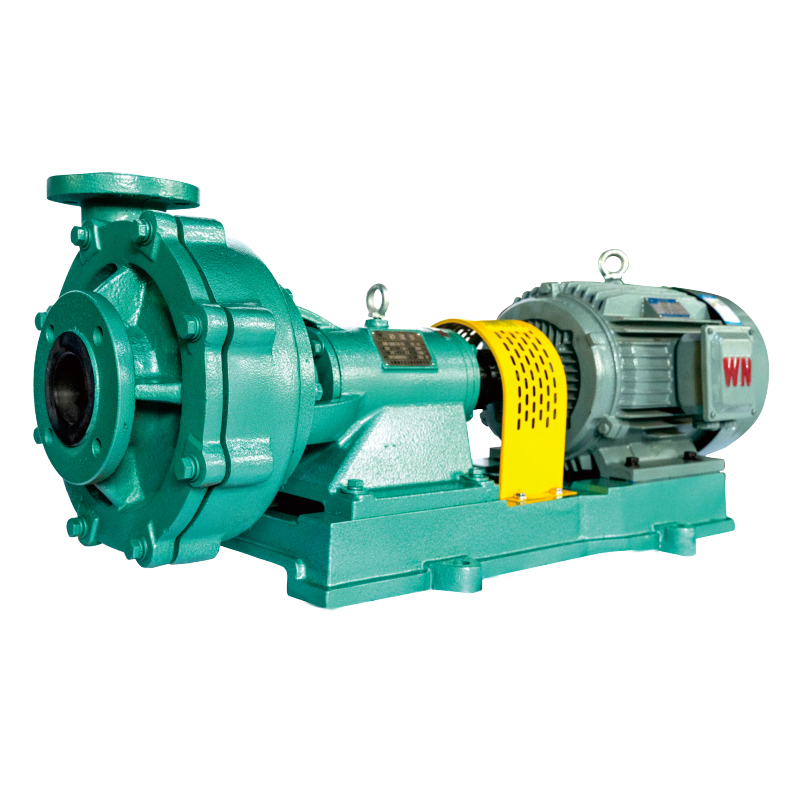
For services involving concentrated sulfuric acid, hydrochloric acid, hydrofluoric acid, strong alkalis, or mixed corrosives — applications common in chemical processing, electroplating, and flue gas treatment — fluoroplastic-lined impellers provide resistance that no metallic alloy can match at comparable cost. The fluoroplastic encapsulation process bonds the corrosion-resistant polymer to a metal substrate, providing structural strength while presenting only the inert fluoroplastic surface to the process fluid. For corrosive services that also carry suspended particles — such as desulfurization slurries, phosphate fertilizer solutions, or mining effluents — the UHB-ZK anti-wear slurry pump combines a UHMWPE wetted path with a semi-open impeller geometry specifically engineered for this dual corrosion-abrasion challenge.
Impeller Wear: Causes, Indicators, and Replacement Timing
All impellers wear over time, but the rate of degradation and the mode of failure differ significantly depending on whether the primary mechanism is hydraulic erosion, chemical corrosion, abrasive wear from suspended solids, or cavitation damage. Identifying the mechanism early allows corrective action — whether operational adjustment, material upgrade, or targeted maintenance — before failure becomes catastrophic.
Performance-Based Wear Indicators
The most reliable early indicator of impeller wear is a measurable decline in pump performance at constant speed and system conditions. As vane surfaces roughen and vane tip clearances increase through wear, hydraulic losses rise and volumetric efficiency falls — producing lower flow rates and reduced head at the same operating point. A pump delivering 10–15% less flow than its original design point under identical system conditions, without any change in system resistance, is exhibiting classic impeller wear. Trending pump performance against the original manufacturer's curve at regular intervals — quarterly in abrasive services, annually in clean services — is the most cost-effective condition monitoring approach available.
Vibration and Noise Indicators
Asymmetric vane wear, material loss from cavitation pitting, or partial clogging of a vane passage creates hydraulic imbalance in the impeller — producing elevated vibration levels at shaft rotational frequency and its harmonics. Rising vibration amplitude at 1× and 2× running speed, detected by permanently mounted accelerometers on bearing housings, is a reliable indicator of impeller deterioration. Cavitation specifically produces a characteristic broadband noise often described as pumping gravel, which is distinct from the tonal vibration signature of mechanical unbalance.
Replacement Decision Criteria
The practical threshold for impeller replacement is reached when: performance degradation exceeds 15% of original rated flow or head and cannot be recovered through clearance adjustment (applicable to open and semi-open impellers); visible pitting, cracking, or material loss on vane surfaces is detected during inspection; running vibration at 1× speed has increased more than 50% from the baseline established at commissioning; or operating efficiency has declined to the point where energy costs over the remaining service period exceed the cost of a new impeller. In abrasive chemical services, a planned replacement interval — rather than a run-to-failure approach — is typically more economical because unplanned failure in aggressive media creates both safety hazards and extended downtime. For a complete reference on impeller geometry, vane angle optimization, and design parameters relevant to replacement specification, our centrifugal pump impeller design guide provides the technical foundation needed to specify a replacement that meets or exceeds original performance.

 Tel: +86-15256327373
  E-mail:
  Add: Anhui Southern Chemical Pump Co., Ltd. The intersection of Kaicheng Road and Fuxing Road, Jing Country, Xuancheng City, Anhui Province