


 English
 русский
 Español
 عربى
عربى
Content
- 1 The Core Difference: How Each Pump Type Moves Corrosive Fluid
- 2 Flow Rate, Pressure, and Viscosity: Performance Under Chemical Duty
- 3 Seal Design and Leakage Risk in Hazardous Fluid Applications
- 4 Material Compatibility: Fluoroplastic-Lined vs Metallic Housings
- 5 Application Mapping: Which Pump Fits Which Chemical Process
- 6 Making the Final Selection for Corrosive and High-Temperature Duties
The Core Difference: How Each Pump Type Moves Corrosive Fluid
When the fluid being pumped is hydrochloric acid, sodium hypochlorite, or a concentrated solvent, the choice between a centrifugal pump and a positive displacement pump becomes more than a performance question — it becomes a safety and containment question. The fundamental operating principles of each pump type produce very different risk profiles when the process fluid is hazardous.
A centrifugal pump transfers energy to the fluid through a spinning impeller. As the impeller rotates, it accelerates fluid outward by centrifugal force, converting kinetic energy into pressure at the discharge point. Flow is continuous and non-pulsating, and the pump responds dynamically to changes in system pressure — as back-pressure rises, flow rate drops along a characteristic curve. For low-viscosity corrosive fluids at moderate concentrations, this is an efficient and reliable mechanism.
A positive displacement pump operates on an entirely different principle. It draws a fixed volume of fluid into a cavity — formed by pistons, gears, lobes, diaphragms, or screws — and forces that volume out through the discharge port with each cycle. Flow is proportional to pump speed and remains nearly constant regardless of discharge pressure. This pressure-independent flow behavior makes positive displacement pumps the preferred choice when precise dosing of a corrosive chemical is required, regardless of how system back-pressure fluctuates downstream.
The distinction matters in chemical duty because both pump types must contain the process fluid under all operating conditions. How they accomplish containment — and where they are vulnerable to failure — differs significantly between the two designs.
Flow Rate, Pressure, and Viscosity: Performance Under Chemical Duty
The performance curves of centrifugal and positive displacement pumps diverge most visibly when system conditions deviate from design point — and in chemical processing, conditions rarely hold steady for long.
Centrifugal pump efficiency peaks at the Best Efficiency Point (BEP) on its flow-head curve. Operating significantly above or below BEP increases mechanical stress, generates excess heat, and accelerates wear on wetted components — a particularly costly outcome when those components are expensive corrosion-resistant alloys or fluoroplastic linings. The U.S. Department of Energy's guidance on centrifugal pump energy efficiency for industrial systems emphasizes that operating pumps away from BEP is one of the primary sources of avoidable energy loss and premature component failure in industrial facilities.
Viscosity is where centrifugal pumps encounter their most significant limitation in chemical service. As fluid viscosity increases, the frictional losses inside the impeller and casing rise steeply, causing flow rate and efficiency to drop in tandem. At viscosities above approximately 200–300 centipoise, centrifugal pump performance degrades substantially. Positive displacement pumps, by contrast, typically become more efficient as viscosity increases — the thicker fluid seals internal clearances more effectively, reducing slip and improving volumetric efficiency.
| Parameter | Centrifugal Pump | Positive Displacement Pump |
|---|---|---|
| Flow behavior vs. pressure | Flow decreases as pressure rises | Flow remains constant regardless of pressure |
| Viscosity handling | Best below ~200 cP; efficiency drops sharply above | Performs well at high viscosity; efficiency improves |
| Dosing / metering accuracy | Poor — flow varies with system conditions | Excellent — fixed volume per cycle |
| Shear-sensitive fluids | Not suitable — impeller damages fluid structure | Suitable — gentle, low-shear displacement |
| Self-priming capability | Usually requires priming | Most types are self-priming |
| High-flow, low-viscosity duty | Ideal — efficient and cost-effective | Less economical at high flow rates |
For the majority of large-volume corrosive fluid transfer applications — moving dilute acid between storage tanks, circulating cooling water through a chemical reactor jacket, feeding a scrubber system — centrifugal pumps deliver higher flow rates at lower capital and operating cost. The trade-off is that they require careful system design to keep the pump operating near its BEP under real process conditions.
Seal Design and Leakage Risk in Hazardous Fluid Applications
In standard water or utility service, a small pump seal leak is a maintenance inconvenience. In chemical service involving acids, chlorinated solvents, or toxic intermediates, the same leak is a safety incident, a regulatory event, and a corrosion source for surrounding equipment. Seal design is therefore one of the most consequential factors in pump selection for hazardous chemical duty.
Conventional centrifugal pumps use mechanical shaft seals — a rotating face pressed against a stationary face, maintained by spring loading and lubricated by the process fluid itself. In corrosive service, mechanical seals require careful material selection: silicon carbide or tungsten carbide faces, fluoroelastomer O-rings, and wetted metal components in Hastelloy or duplex stainless steel. Even with correct material selection, mechanical seals wear, and worn seals leak. High-temperature operation, dry-running events, and abrasive particles in the fluid all accelerate seal degradation.
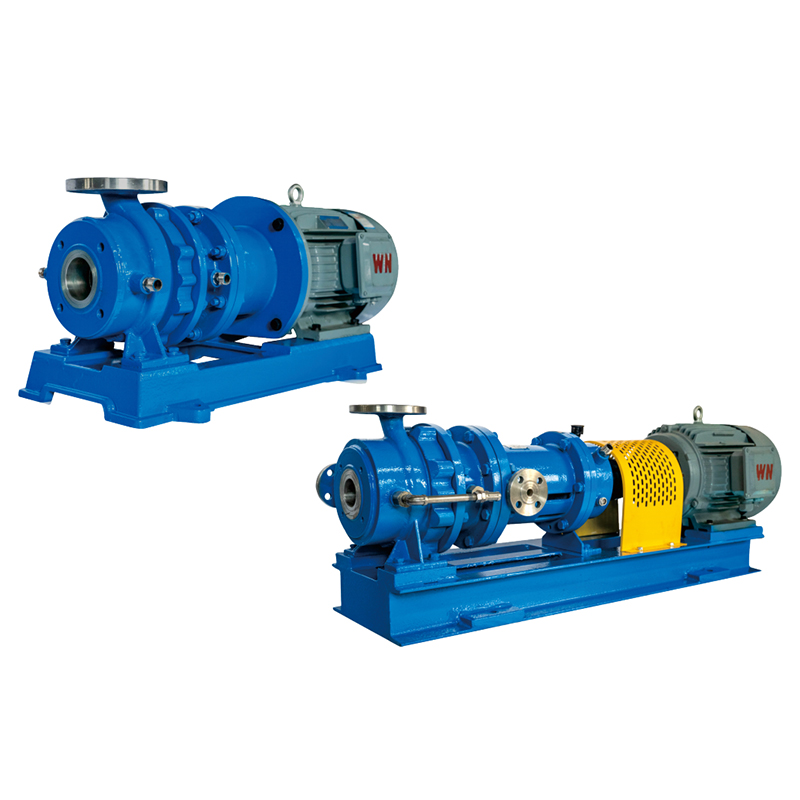
The engineering response to mechanical seal risk in hazardous chemical applications is the magnetically driven pump. In a magnetic drive centrifugal pump, the motor shaft and impeller shaft are coupled through a magnetic field transmitted across a static containment shell — there is no physical shaft penetration through the pump casing at all. The process fluid is fully enclosed with zero dynamic seals. leak-free magnetic drive pumps for hazardous and toxic chemical applications eliminate the primary failure mode of conventional centrifugal pumps in aggressive chemical service, making them the preferred specification for fuming acids, carcinogens, and volatile organic compounds where any fugitive emission is unacceptable.
Positive displacement pumps present a different sealing challenge. Reciprocating types — piston, plunger, diaphragm — use packing or diaphragm membranes to isolate the fluid from the drive mechanism. Diaphragm pumps in particular offer excellent containment for corrosive dosing applications: the diaphragm physically separates the fluid chamber from the mechanical drive, and double-diaphragm designs with leak detection provide an additional safety layer. For low-flow, high-precision dosing of concentrated corrosives, a diaphragm-type positive displacement pump often provides the best combination of containment integrity and metering accuracy.
Material Compatibility: Fluoroplastic-Lined vs Metallic Housings
Pump selection for corrosive service cannot be separated from wetted material selection. The pump type determines the hydraulic behavior; the construction material determines whether the pump survives contact with the process fluid. In many chemical applications, material compatibility is the primary selection driver — only after a material is confirmed compatible does performance optimization become relevant.
Fluoroplastic linings — PTFE, ETFE, PVDF, and FEP — provide exceptional resistance to a broad range of aggressive chemicals including concentrated sulfuric acid, hydrofluoric acid, strong oxidizers, and most organic solvents. Fluoroplastic-lined centrifugal pumps achieve this protection by coating or molding a fluoropolymer layer over a metallic casing, isolating all wetted surfaces from the process fluid. fluoroplastic-lined centrifugal pumps engineered for corrosive acid and alkali transfer combine the hydraulic efficiency of a centrifugal design with chemical inertness across nearly the full pH range — making them the dominant choice for bulk acid and alkali transfer in chemical manufacturing and water treatment.
For positive displacement pumps in corrosive service, material selection depends heavily on pump subtype. Gear and lobe pumps handling corrosive fluids require all-wetted metallic components in corrosion-resistant alloys — Hastelloy C-276 for oxidizing acids, duplex stainless for chloride-containing streams. Diaphragm pumps handling highly corrosive or ultra-pure chemicals typically use PTFE-coated or solid PTFE fluid chambers and diaphragms, achieving the same chemical inertness as a fluoroplastic-lined centrifugal pump while retaining the metering precision of a positive displacement design.
Temperature is a compounding factor. Fluoroplastic linings begin to soften above approximately 150°C depending on the specific polymer. At elevated temperatures — hot concentrated sulfuric acid above 120°C, for example — all-metallic pump construction in appropriate alloys may be the only viable option, and pump type selection narrows accordingly.
Application Mapping: Which Pump Fits Which Chemical Process
The selection decision between centrifugal and positive displacement pumps in chemical service resolves clearly once the key process parameters are defined. The table below maps the most common chemical processing scenarios to the appropriate pump type based on viscosity, flow rate, pressure requirements, fluid sensitivity, and containment demands.
| Application | Key Parameters | Recommended Pump Type | Notes |
|---|---|---|---|
| Bulk acid / alkali transfer | High flow, low viscosity, corrosive | Centrifugal (fluoroplastic-lined) | Magnetic drive if volatile or toxic |
| Chemical dosing / metering | Low flow, precise volume, variable back-pressure | Positive displacement (diaphragm) | PTFE wetted parts for strong acids |
| Viscous polymer / resin transfer | High viscosity (>500 cP), moderate pressure | Positive displacement (gear or lobe) | Alloy wetted parts for reactive resins |
| Fuming acid circulation (HF, HNO₃) | Low to moderate flow, high toxicity, zero-leak required | Centrifugal (magnetic drive, PTFE-lined) | No mechanical seals permitted |
| Scrubber / reactor feed | Continuous high flow, dilute corrosive | Centrifugal | Standard lined pump with mechanical seal |
| Slurry with corrosive carrier fluid | Abrasive solids + corrosive liquid | Centrifugal (rubber-lined or hard alloy) | Avoid PD pumps — solids damage close-tolerance parts |
Making the Final Selection for Corrosive and High-Temperature Duties
A structured selection process eliminates most of the ambiguity in the centrifugal versus positive displacement decision for chemical applications. Three questions should be resolved in sequence before any pump is specified.
First: is the fluid compatible with the pump's wetted materials across the full operating temperature range? Material incompatibility is a disqualifying condition regardless of hydraulic performance. Confirm chemical resistance data for every wetted component — casing, impeller or rotor, seals, and O-rings — against the process fluid at maximum operating temperature and concentration. Fluoroplastic linings and PTFE-wetted positive displacement pumps cover the widest chemical range; metallic constructions require more careful individual assessment.
Second: does the application require constant flow rate independent of system pressure, or high-volume continuous transfer? Precise chemical dosing, proportional blending, and metering into pressurized reactors all point to positive displacement. High-volume transfer between tanks, circulation loops, and cooling circuits all point to centrifugal. If both requirements exist simultaneously in the same process line, they typically require separate pump circuits.
Third: what is the consequence of a seal failure? For fluids where any fugitive emission is unacceptable — carcinogens, acutely toxic chemicals, volatile acids — sealless construction should be the baseline requirement, not an upgrade option. Magnetic drive centrifugal pumps and double-diaphragm positive displacement pumps both address this requirement through fundamentally different mechanisms suited to different flow and viscosity regimes.
Matching pump type, construction material, and seal design to the actual chemical process parameters — rather than defaulting to the most familiar equipment type — is the decision that determines long-term reliability and operating cost. full range of chemical centrifugal pump models for industrial fluid handling provides a starting point for evaluating fluoroplastic-lined and magnetic drive options across the full range of corrosive process duties.

 Tel: +86-15256327373
  E-mail:
  Add: Anhui Southern Chemical Pump Co., Ltd. The intersection of Kaicheng Road and Fuxing Road, Jing Country, Xuancheng City, Anhui Province