


 English
 русский
 Español
 عربى
عربى
Content
- 1 How a Multi-Stage Centrifugal Pump Builds Pressure
- 2 Multi-Stage vs Single-Stage: Which One Actually Fits Your System
- 3 Core Design Elements That Determine Reliability
- 4 Where Multi-Stage Pumps Are Used
- 5 Material and Sealing Considerations for Corrosive Duty
- 6 Selection Checklist Before You Specify a Pump
How a Multi-Stage Centrifugal Pump Builds Pressure
A single impeller can only push fluid so far before the physics run out. Once a system calls for more head than one stage can deliver, engineers stack impellers on a common shaft, feeding the discharge of one directly into the suction of the next. Each stage adds its own increment of pressure, so a pump with six stages can reach roughly six times the head of an identical single-stage unit running at the same speed.
Between each impeller sits a diffuser — a ring of fixed vanes that slows the fluid down and converts its velocity into pressure before handing it off to the next stage. This is different from the volute casing found on most single-stage pumps, and it's the reason multi-stage units can hold tight tolerances at high pressure without the turbulence losses a volute would introduce at that scale. For readers who want the underlying fluid dynamics spelled out in more depth, this breakdown of centrifugal pump working principles and selection criteria covers the impeller and casing mechanics stage by stage.
Multi-Stage vs Single-Stage: Which One Actually Fits Your System
The decision usually comes down to one number: how much head does the application actually need. Single-stage pumps handle most general transfer duty — clean water, mild chemicals, moderate-pressure circulation — at a lower cost and with far fewer wear parts to maintain. Multi-stage pumps earn their keep when the discharge pressure requirement climbs well beyond what one impeller can produce: boiler feed water, high-rise water supply, reverse osmosis pretreatment, or deep-well extraction.
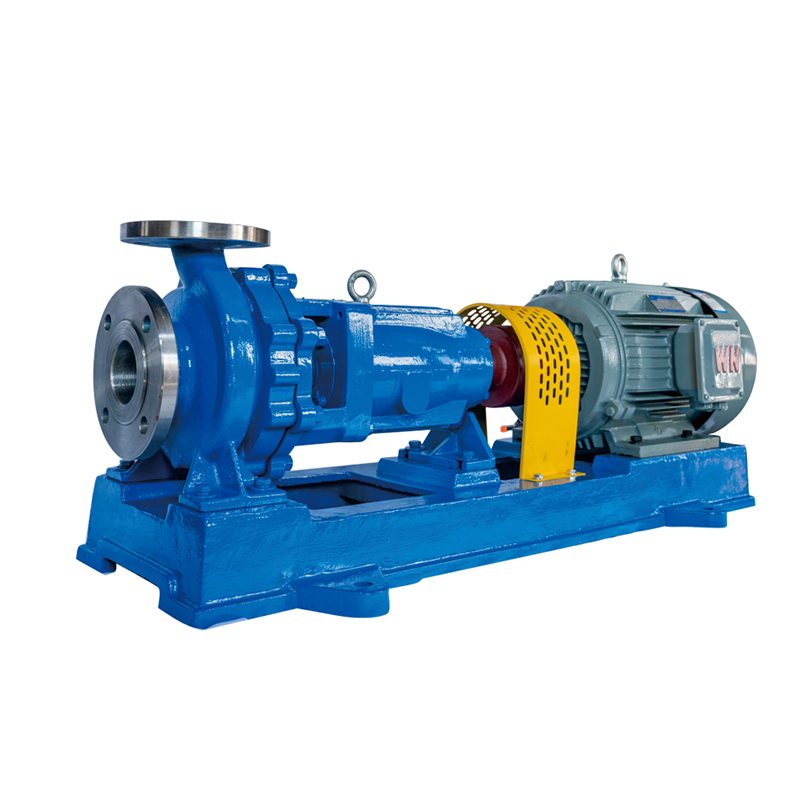
There's a cost trade-off worth naming plainly. More stages mean more seals, more bearings, and a longer rotor that has to stay precisely aligned — which raises both the purchase price and the long-term maintenance burden. In plenty of chemical processing applications, the smarter move is a properly sized single-stage pump, or two single-stage units in series, rather than a complex multi-stage assembly built for pressures the process doesn't actually require. South Pump's range of chemical-duty centrifugal pumps built for corrosive fluid handling covers exactly that middle ground, where a well-specified single-stage unit outperforms an over-engineered multi-stage one on cost and serviceability.
Core Design Elements That Determine Reliability
Stacking impellers in series creates a problem single-stage pumps don't have to solve: axial thrust. Because every impeller faces the same direction, the cumulative hydraulic force pushes hard against the shaft, and without correction it would quickly destroy the bearings. Manufacturers handle this with a balance drum or balance disc — a component sized specifically to counteract that thrust using pressure from the final stage. Getting this wrong is one of the most common causes of premature bearing failure in multi-stage installations.
Orientation matters too. Horizontal multi-stage pumps are easier to service since the rotor can be pulled without disturbing the piping, and they suit installations where floor space isn't a constraint. Vertical multi-stage pumps take up a smaller footprint and are common where the pump has to sit close to a wellhead or in a tight mechanical room, though the motor typically has to come off before the rotor can be inspected.
| Factor | Horizontal | Vertical |
|---|---|---|
| Footprint | Larger | Compact |
| Maintenance access | Easier rotor pull | Motor removal usually required |
| Typical use | Boiler feed, process plants | Well pumping, space-constrained sites |
Where Multi-Stage Pumps Are Used
Power plants rely on multi-stage pumps to push feed water into boilers operating at hundreds of PSI. Municipal and commercial water systems use them to pressurize supply lines in high-rise buildings, where a single stage simply can't overcome the elevation. Reverse osmosis plants depend on them to force water through membranes at the pressures needed for effective filtration, and upstream oil and gas operations use vertical multi-stage designs to lift fluid from deep wells.
What these applications share is a pressure requirement that rules out a single-stage solution from the start — the head, not the flow rate, is what drives the pump selection.
Material and Sealing Considerations for Corrosive Duty
High pressure and aggressive chemistry rarely show up in isolation, and when they do, material selection becomes the deciding factor in pump life. Stainless steel grades like 316L handle most acidic and saline environments, but for genuinely harsh chemical duty — strong acids, chlorinated solvents, high-temperature caustics — PTFE linings or specialty alloys are often the only materials that hold up without accelerated wear on the impeller and casing.
Sealing deserves equal attention. Mechanical seals are the default for corrosive service since they isolate the process fluid far more effectively than packing glands, but seal face material has to match the fluid chemistry or the seal becomes the first failure point rather than the pump itself. South Pump's stainless steel centrifugal pump line rated for high-temperature corrosive service is built around this exact problem — handling neutral-to-corrosive liquids across a wide temperature band without the added complexity of a multi-stage rotor. For a closer look at how material choice and maintenance schedules interact over the life of a chemical pump, this guide to material selection and maintenance for chemical centrifugal pumps goes through the trade-offs in more detail. Design and testing requirements for centrifugal pumps in demanding process services are also formalized in the API 610 standard catalog for petroleum and petrochemical pump equipment, which remains the reference point for both single- and multi-stage designs in heavy industrial use.
Selection Checklist Before You Specify a Pump
Before requesting quotes, nail down the numbers that actually drive the decision:
- Required total dynamic head and flow rate at the operating point, not just at startup
- Fluid chemistry — pH, temperature, and any solids or fiber content
- Whether the head requirement genuinely needs multiple stages or could be met with a correctly sized single-stage pump
- Available installation footprint and whether horizontal or vertical mounting fits the site
- Seal type and material compatibility with the process fluid
Getting this list wrong is what leads to the two most common failure modes: a pump that can't hit the pressure the system needs, or one that's oversized, overpriced, and harder to maintain than the job called for. Once these parameters are locked down, keeping the pump running reliably comes down to disciplined upkeep — this routine maintenance checklist for centrifugal pump reliability lays out what to check daily, quarterly, and annually.

 Tel: +86-15256327373
  E-mail:
  Add: Anhui Southern Chemical Pump Co., Ltd. The intersection of Kaicheng Road and Fuxing Road, Jing Country, Xuancheng City, Anhui Province