


 English
 русский
 Español
 عربى
عربى
Content
How a Centrifugal Pump Moves Fluid
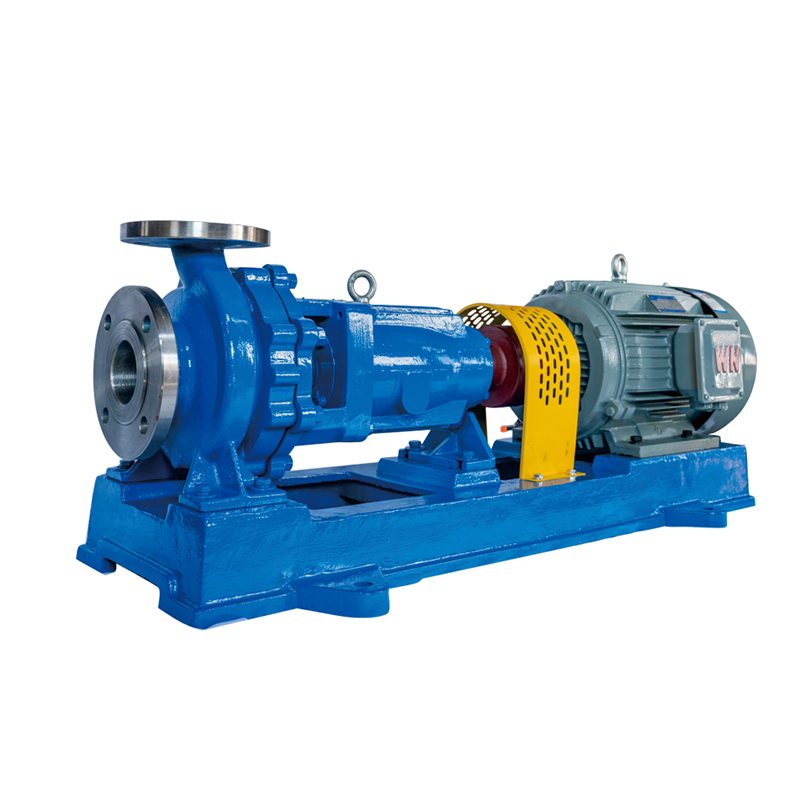
A spinning impeller inside the pump casing throws fluid outward through centrifugal force, and the volute-shaped housing converts that velocity into pressure as the fluid exits through the discharge port. This single mechanical action explains why centrifugal pumps dominate industrial fluid handling: they have no valves, pistons, or reciprocating parts to wear out under continuous operation.
The result is a pump family suited to continuous, high-flow duty rather than the pulsing delivery of positive displacement pumps. For a chemical-grade centrifugal pump product line, that means steady output across long production runs, provided the pump is sized and built for the fluid it will actually see.
Where the design gets interesting is at the suction side. Cavitation, the formation and collapse of vapor bubbles inside the impeller eye, remains the single most common cause of premature pump failure. It happens when available suction pressure drops below the fluid's vapor pressure, and it pits impeller vanes within weeks if left unaddressed.
Flow Rate, Head, and the Best Efficiency Point
Every centrifugal pump is defined by a curve, not a single number. Flow rate (measured in m³/h or gpm) and head (the height the pump can lift fluid, expressed in meters or feet) trade off against each other along that curve, and the point where the pump runs at its highest efficiency is called the Best Efficiency Point, or BEP.
Operating far from BEP is where problems start. Run a pump well below its rated flow and internal recirculation heats the fluid, accelerates seal wear, and increases radial shaft loading. Push it past BEP and you risk starving the impeller of the net positive suction head it needs, inviting the exact cavitation problem described above.
- Match rated flow to actual system demand, not to a rounded-up "safety margin"
- Check the pump curve against your system curve before purchase, not after installation
- Keep normal operation within roughly 70–120% of BEP flow
The Hydraulic Institute's published pump testing and performance standards define exactly how BEP and acceptance tolerances are measured, which is worth checking whenever a manufacturer's curve looks unusually optimistic.
Matching Pump Material to Your Fluid
Flow and head get a pump moving; material selection decides whether it survives the fluid. Corrosive, abrasive, or high-purity media each demand a different wetted-parts strategy, and getting this wrong is the fastest way to turn a properly sized pump into a six-month liability.
| Fluid Condition | Recommended Material | Why |
|---|---|---|
| Neutral to mildly corrosive liquids | Stainless steel | Balances cost with broad chemical resistance |
| Strong acids or alkalis | Fluoroplastic-lined alloy | Isolates metal parts from direct chemical contact |
| Abrasive slurries with corrosive content | Anti-wear rubber or ceramic lining | Resists erosion from suspended solids |
For standard industrial and light chemical service, a stainless steel centrifugal pump for standard chemical duty covers most applications without the added cost of exotic linings. Once the process involves concentrated acids, sodium hydroxide, or other aggressive chemistry, a fluoroplastic-lined centrifugal pump built for strong acids and alkalis becomes the safer default, since the fluoropolymer barrier isolates the metal housing entirely from the process fluid.
Seal selection deserves equal attention. Mechanical seals rated for the wrong chemical family fail quietly at first, then all at once. A more detailed in-depth guide to material compatibility and seal selection walks through elastomer and seal-face combinations by chemical family.
Common Centrifugal Pump Configurations
Not every application calls for the same pump body. Single-stage end suction models cover the majority of general transfer duties, but three configurations regularly outperform them in specific conditions.
- Self-priming pumps handle intermittent runs where the suction line may drain between cycles, avoiding the need to manually re-prime each start.
- Multistage pumps stack several impellers in series to reach high head requirements, common in boiler feed and reverse osmosis systems.
- Slurry-duty pumps use thicker, wear-resistant linings and open impeller designs to move particle-laden or abrasive fluids without rapid erosion.
For processes carrying suspended solids alongside corrosive chemistry, such as mining effluent or flue-gas desulfurization slurry, an anti-wear slurry pump for corrosive particle-laden media is built specifically for that dual challenge, rather than asking a standard chemical pump to compromise on both fronts.
Installation and Maintenance Considerations
A correctly selected pump still needs a correctly built system around it. Suction piping should be as short and straight as practical, since elbows placed too close to the inlet create uneven flow that stresses the impeller asymmetrically over time.
Baseplate alignment matters more than most installers expect. Misalignment between motor and pump shaft, even by a fraction of a millimeter, translates into bearing wear and seal leakage within months rather than years. A laser alignment check at commissioning pays for itself many times over.
On the maintenance side, three checks catch most emerging problems before they become failures:
- Monitor vibration and bearing temperature at fixed intervals rather than waiting for audible noise
- Inspect mechanical seals for weeping during scheduled shutdowns, not only after visible leaks appear
- Track discharge pressure against the original pump curve to catch impeller wear or clogging early
None of these steps require specialized tools, but they do require a schedule that someone actually follows. Pumps rarely fail without warning signs; they fail after the warning signs get ignored.

 Tel: +86-15256327373
  E-mail:
  Add: Anhui Southern Chemical Pump Co., Ltd. The intersection of Kaicheng Road and Fuxing Road, Jing Country, Xuancheng City, Anhui Province