


 English
 русский
 Español
 عربى
عربى
Content
- 1 What the Impeller Actually Does Inside a Pump
- 2 Closed, Semi-Open, and Open Impellers: Matching Structure to Fluid
- 3 Impeller Material: Why Corrosion Resistance Comes First in Chemical Duty
- 4 How Impeller Design Changes in Magnetic Drive Pumps
- 5 Cavitation and Wear: The Two Ways Impellers Fail
- 6 Choosing the Right Impeller for Your Application
What the Impeller Actually Does Inside a Pump
Cut open a centrifugal pump and the impeller is the part doing the actual work — a rotating disc fitted with curved vanes, spinning at the center of the casing. As it turns, it pulls fluid in through its eye and flings it outward along the vanes, converting the motor's rotational energy into velocity and pressure.
That outward motion is centrifugal force in its most literal sense. Fluid enters near the shaft where pressure is lowest, accelerates as it moves along the vane channels, and exits at the outer edge into the volute casing, where velocity converts into the head and flow the pump delivers downstream.
Every other design decision in a pump — casing shape, seal type, motor sizing — exists to support what the impeller is doing. Get the impeller wrong for the application, and no amount of correct engineering elsewhere fixes it.
Closed, Semi-Open, and Open Impellers: Matching Structure to Fluid
Impellers come in three structural families, and the difference between them is really about how much clearance the fluid has to work with. Closed impellers have shrouds on both sides of the vanes, sealing the flow path into defined channels. This design is the most efficient at converting energy into head, but it only works with clean, particle-free fluids — anything solid gets trapped between the shroud and casing.
Semi-open impellers drop the front shroud, leaving the vanes exposed on one side. That extra clearance lets small particles and light slurries pass through the channel without immediately clogging it, at some cost to efficiency. A semi-open impeller pump built for slurries with suspended solids is a direct example of this tradeoff in practice — the open channel design keeps particles moving instead of accumulating.
Open impellers go further, consisting of nothing but vanes attached to a hub with no shroud at all. They handle the largest solids and the dirtiest fluids, but efficiency drops the most of the three designs since there's no shroud to contain the flow path.
Impeller Material: Why Corrosion Resistance Comes First in Chemical Duty
Material choice matters more for an impeller than almost any other pump component, because it sits directly in the fluid path with no protective lining to fall back on if it fails. For clean water or mild fluids, cast iron or bronze impellers do the job at low cost. For anything corrosive, that changes fast.
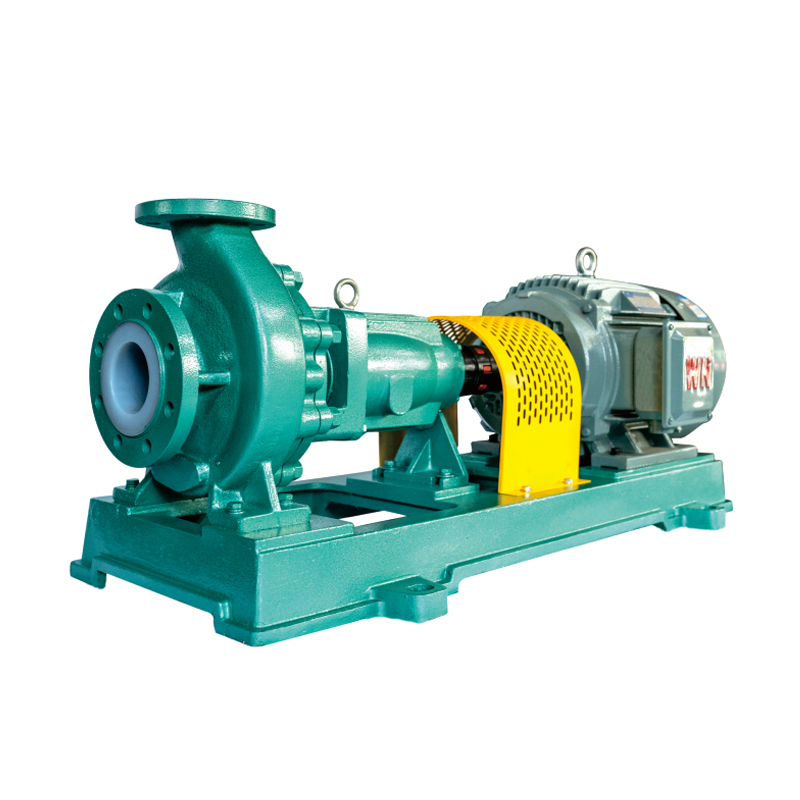
Stainless steel handles moderate acids and alkalis reasonably well but struggles against chlorides and hydrochloric acid specifically. For genuinely aggressive media — concentrated sulfuric acid, hydrofluoric acid, strong oxidizers — fluoroplastic-encapsulated impellers hold up where metal alloys would corrode within months. A fluoroplastic-lined chemical centrifugal pump for highly corrosive media uses exactly this approach, encapsulating a metal insert in fluoroplastic through sintering rather than relying on a metal alloy alone.
The tradeoff is cost and, in some cases, mechanical strength at very high pressures — which is why material selection almost always comes down to matching the impeller to the specific chemical, concentration, and temperature it will see in service, not defaulting to the most corrosion-resistant option available.
How Impeller Design Changes in Magnetic Drive Pumps
A magnetic drive pump moves the impeller's power source outside the fluid path entirely. Instead of a shaft running directly through a mechanical seal, the impeller is coupled to an inner magnet that spins in sync with an outer magnet driven by the motor — no shaft penetration, no seal, no leak path for hazardous fluid to escape through.
This changes what the impeller has to accommodate mechanically, since it now needs to house the inner magnet assembly rather than mount directly on a driveshaft. The full range of magnetic drive pumps spans this design across different materials and pressure ratings, and a stainless steel magnetic drive pump with a sealless design shows how the same impeller principles apply even without a conventional shaft seal in the equation.
For volatile or toxic fluids where any leakage is unacceptable, this sealless configuration is often the deciding factor over a conventional mechanically-sealed pump, impeller design considerations aside.
Cavitation and Wear: The Two Ways Impellers Fail
Cavitation is the more dramatic failure mode. When suction pressure drops below the fluid's vapor pressure, tiny vapor bubbles form near the impeller eye. As those bubbles travel into the higher-pressure region of the vane channel, they collapse violently, and the resulting micro-jets pit and erode the impeller surface over time — a process that sounds, in the field, like gravel rattling inside the casing.
Avoiding it comes down to keeping available suction head above what the impeller requires, with margin. The Hydraulic Institute's published pump standards define how NPSH testing and margins are established across the industry, which is why manufacturers reference these figures rather than arbitrary safety numbers.
Wear is the quieter failure mode, driven by suspended particles abrading the vane surfaces over months or years rather than one catastrophic event. This is where impeller structure and material both matter — an open impeller in an abrasion-resistant material handles gradual wear far better than a closed impeller never designed for particle contact in the first place.
Choosing the Right Impeller for Your Application
Three questions narrow the decision quickly. What's actually in the fluid — clean liquid, light particulates, or heavy slurry — determines whether a closed, semi-open, or open design is appropriate. What's the fluid's chemistry — mild, moderately corrosive, or aggressive — points toward stainless steel, a fluoroplastic lining, or something in between. And does any leakage risk exist that would justify the added cost of a sealless magnetic drive configuration.
Getting these three right upfront avoids the more expensive alternative: replacing an impeller (or an entire pump) that failed prematurely because it was mismatched to the job from the start. A detailed guide to chemical centrifugal pump selection, materials, and maintenance walks through this decision process in more depth, including how material choice interacts with sealing technology and long-term maintenance planning.

 Tel: +86-15256327373
  E-mail:
  Add: Anhui Southern Chemical Pump Co., Ltd. The intersection of Kaicheng Road and Fuxing Road, Jing Country, Xuancheng City, Anhui Province